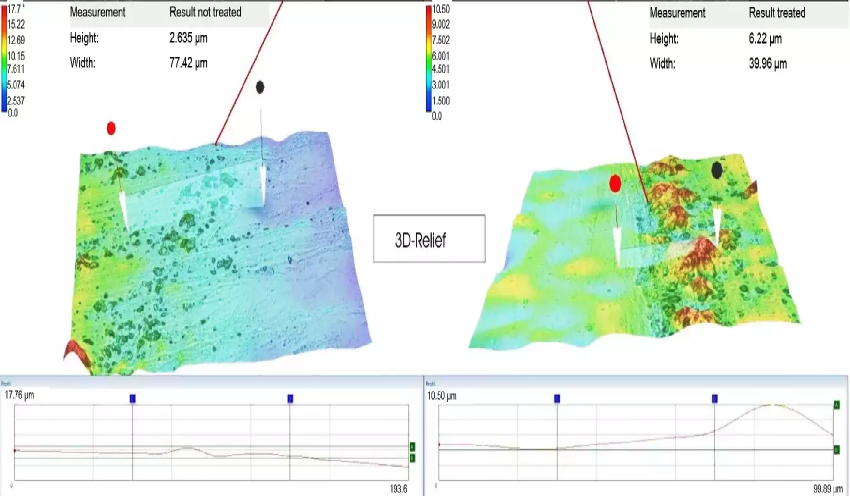
3D microscope illustration of the Scalewatcher treatment
Scaling is mainly caused by supersaturation, with carbonate hardness — calcium bicarbonate, Ca(HCO₃)₂ — playing the key role in scale formation.
Electronic and magnetic water treatment influences the nucleation process, changing the number, size, and shape of the crystals. Instead of forming matted structures that stick to pipe walls, Scalewatcher treatment creates smaller, rounder, scattered crystals that are easily carried away by flowing water.
According to recent scientific models, electromagnetic fields can also help reposition charged colloidal clusters in the water, reducing their tendency to adhere to surfaces. The overall result is less deposit buildup and easier removal through normal water flow.
Existing scale is removed gradually. After Scalewatcher treatment, minerals are less likely to attach to the scale, so some of the deposit can slowly dissolve back into the water.
Scale is also built up in layers. The bonds between these layers are often weaker, so flowing water can loosen them over time and carry the released particles away.
Flowing water is therefore essential for best performance. In low-flow or stagnant systems, such as dishwashers, humidifiers, evaporators, and some steam boilers, scale may still form, but it is usually softer, builds up more slowly, and is easier to clean.
These microscope images compare treated water on the left with untreated water on the right.
The treated water leaves a flatter, more spread-out mineral residue. In the untreated water, the minerals clump together and form a higher, rougher layer—the beginning of hard scale.
The measurements show that treated particles are about 2.5 µm high, while untreated particles average about 6.5 µm and can exceed 10 µm. This shows that Scalewatcher changes how the minerals form, making them less likely to stick and create hard scale.
General explanation
Distribution of crystal size
 Distribution of crystal size